 Japanese

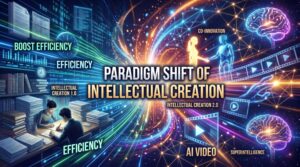
The “Output Revolution” brought about by generative AI refers to a profound transformation in intellectual production: whereas conventional AI excelled at analyzing and classifying data (processing input), generative AI can instantly create tangible deliverables (output)—such as text, images, code, audio commentary, presentation slides, and video—at a quality on par with, or even surpassing, that of human work.
This is truly called a “revolution” because it goes far beyond simple workflow efficiency; it serves as a comprehensive catalyst for unlocking individual creativity and fundamentally reshaping how work gets done.
Specifically, the following shifts are taking place:
Table of Contents
- 12-1: Using AI as a Sounding Board to Flesh Out Ideas
- 12-2: The Democratization of Skills (Breaking Down Specialized Barriers)
- 12-3: Rapid Feedback Loops in Production
12-1: Using AI as a Sounding Board to Flesh Out Ideas
Previously, taking the “first step” (crafting a rough draft)—whether for project proposals, design, programming, or writing—was often a solitary endeavor. By bringing in AI as a discussion partner and thinking companion, you can achieve massive gains in efficiency.
- The Shift: Simply feeding general themes and constraints into the AI yields a “70%-complete draft” or multifaceted ideas within seconds. The human role transforms from a solitary builder starting from scratch (a laborer) into an “editor or creative director” who evaluates, refines, and steers the generated material.
- A Vital Caution: You must never completely outsource ideation to AI. Doing so strips away your individuality and originality, leaving behind only the bland, overly safe, and uninspired concepts typical of generic AI outputs.
- The Sounding Board Approach: Using AI as a sounding board means bouncing your fragmented thoughts, rough notes, and hunches off the system so it can organize, structure, and highlight multiple angles on the topic. What used to take hours of agonizing alone can now be resolved through just a few minutes of back-and-forth dialogue.
- By continuously layering follow-up requests, you can iteratively guide the output toward your exact vision.
12-2: The Democratization of Skills (Breaking Down Specialized Barriers)
Capabilities that once demanded specialized degrees or years of deliberate practice can now be wielded by anyone with a single prompt.
- Design & Illustration: Even without drawing skills, typing the concepts in your head produces professional-grade visual assets.
- Programming: Non-engineers who cannot write code can build functional applications and automation pipelines using simple natural-language instructions.
- Multilingual Communication: Even without foreign language fluency, you can generate and publish natural-sounding multilingual videos while preserving your original voice and tone.
- Slide Deck Creation: Even those who struggle with slide presentations can rapidly generate decks of ten or more polished slides using tools like Nano Banana or Gemini Notebook.
12-3: Rapid Feedback Loops in Production
The traditional workflow—”Ideation → Prototyping → Testing → Revision”—once took days or weeks per iteration. Generative AI compresses this entire cycle down to a matter of minutes.
- Because you can instantly generate and test ten copywriting variations, five design drafts, or five complete proposal angles, the sheer volume of rapid iterations drastically elevates the final quality.
In summary: While high-quality output previously belonged exclusively to those possessing advanced technical skills and vast amounts of time, the generative AI Output Revolution has shifted the paradigm: we have entered an era where what kinds of questions and ideas you can formulate (in the form of prompts) matters most of all.






Comments