 Japanese
2-1: What Is an Ecosystem?
The term “ecosystem” originated as a specialized concept within the field of ecology. The word “ecology” was coined and proposed in 1866 by the German biologist Ernst Haeckel (Haeckel, 1866). It is derived by combining the Greek words oikos (meaning “home” or “dwelling place”) and logos (meaning “study” or “discourse”). Originally, ecology was defined as the scientific study (a branch of biology) examining the interactions between living organisms and their surrounding physical, chemical, organic, and inorganic external environments. Across the 19th and 20th centuries, its scope broadened to pioneer new disciplines such as human ecology and cultural ecology.
Furthermore, the term “ecosystem” was coined by the British plant ecologist Arthur Tansley. He first introduced the concept in his 1935 paper The Use and Abuse of Vegetational Concepts and Terms (Tansley, 1935). Tansley introduced the concept of a “system”—drawn from physics—to replace the vague notion of an “organism.” He asserted that rather than isolating collections of living organisms (plants, animals, and microorganisms), the entire entity—including the inorganic environment in which they exist, such as light, air, water, and soil—must be understood as a unified physical system. Tansley’s formulation marked a critical turning point, transforming ecology from a discipline focused merely on observing and classifying organisms into a modern systems science that analyzes the cycling of matter and the flow of energy through physical and chemical lenses.
Since the 1990s, the term “ecosystem” has also been widely adopted across the business and IT sectors. In this context, a “business ecosystem” refers to a framework in which multiple companies, services, and users are interconnected, collaborating and coexisting synergistically to achieve mutual prosperity.
1. Commonalities Between Natural and Business Ecosystems
Both natural and business ecosystems share the fundamental essence that individual components do not operate in isolation; rather, they form an interdependent system where all elements are closely connected and continuously influence one another.
- Mechanics of the Natural World: Solar energy is absorbed by plants (producers), which are consumed by animals (consumers), whose remains and waste are decomposed by microorganisms (decomposers) to return to the soil—establishing an uninterrupted cycle of matter and energy flow.
- Mechanics of the Business World: Instead of attempting to deliver everything through a single company, businesses engage a broad network of external players, partners, and users. This expands the overall market and generates resilient value and convenience that cannot be easily dismantled.
2. The Apple Business Ecosystem as a Concrete Example
One of the most successful ecosystems today is the Apple economic sphere:
- iPhone (Hardware/Device)
- iOS (Operating System / Infrastructure)
- App Store (Platform)
- App Developers (External service providers, acting as “producers”)
- End Users (“Consumers” of hardware and services)
These components do not exist separately; they form a cohesive, massive economic sphere that yields mutual benefits. When developers create compelling apps, the value of the iPhone increases for users; as the user base grows, more developers are drawn to the platform—creating an exquisite, virtuous cycle of symbiosis.
2-2: The Google Ecosystem
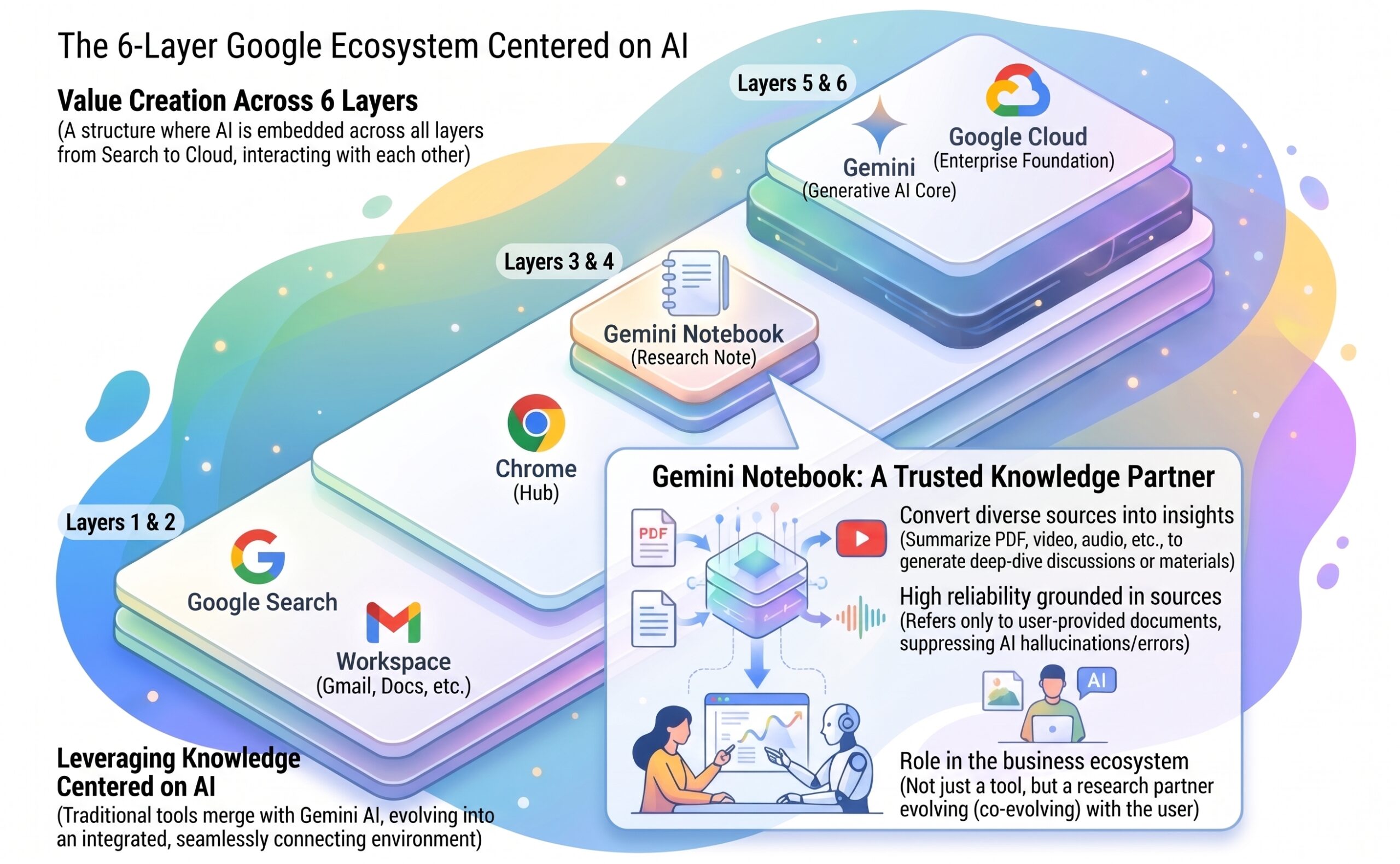
The Google ecosystem refers to an integrated operating environment where Google’s suite of services—including Google Search, Gmail, Google Drive, Google Calendar, Google Docs, Google Meet, Android, and Gemini—interconnect seamlessly under a single account. Because data and settings are shared across services, organizing information, collaborating, and enhancing productivity become effortless, enabling individuals, educational institutions, and enterprises to leverage digital tools with high efficiency. In recent years, AI (Gemini) has been embedded across every layer of the traditional Google ecosystem (Search, Gmail, Maps, etc.), marking a dramatic evolution from a conventional “cloud + apps” framework into a knowledge-leveraging ecosystem centered on AI.
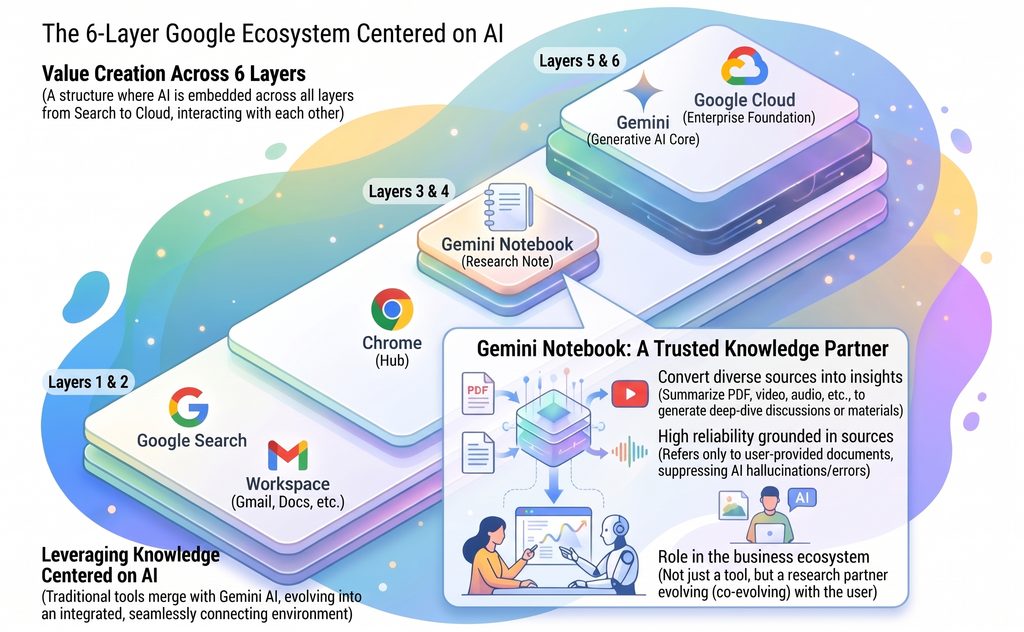
The architecture of the Google ecosystem is structured across the following layers:
- Layer 1: Google Search
The origin of Google’s services, enabling users to explore information worldwide:- Google Search
- Google Scholar
- Google News
- Google Books, etc.
- Layer 2: Google Workspace
A integrated suite of cloud productivity tools encompassing Gmail, Drive, Docs, Calendar, Meet, and more. A single account provides seamless connectivity across document creation, data management, and video conferencing. Furthermore, its integration with Gemini AI enables automated email drafting, data analysis, and meeting summary generation, serving as the core engine powering both personal productivity and enterprise efficiency. Key services include:- Gmail: Email
- Google Drive: Cloud storage
- Google Docs: Document processing
- Google Sheets: Spreadsheets
- Google Slides: Presentation design
- Google Calendar: Scheduling
- Google Meet: Online conferencing
- Google Keep: Note-taking
- Layer 3: Chrome
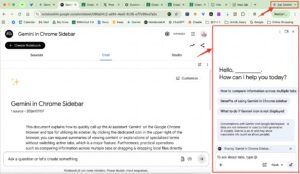
Chrome is no longer just a browser; it has evolved into a central hub (or portal) linking:- Gemini
- Google Drive
- Google Workspace
- Notebook
- Layer 4: Notebook
Gemini Notebook is an AI-powered research and note-taking tool developed by Google. When fed source materials such as PDFs, Google Docs, or web pages, it summarizes contents, answers questions, performs comparative analyses, and automatically generates audio overviews, slide decks, video walkthroughs, and infographics. Because outputs generated by Gemini Notebook are grounded strictly in the uploaded source materials, hallucinations are minimized, significantly streamlining research, learning, and document drafting. - Layer 5: Gemini (Generative AI)
Gemini plays the central role within the Google ecosystem, embedded across virtually every layer. It provides a comprehensive suite of AI capabilities, spanning conversational AI, coding, document writing, research, image generation, video generation, and voice interactions. - Layer 6: Google Cloud
The enterprise-grade tier of the ecosystem. Key services include Vertex AI, BigQuery, Cloud Storage, Cloud SQL, Cloud Run, and Kubernetes Engine. Enterprises deploy and run customized AI systems powered by Gemini within this infrastructure.
The core pillars of intellectual creation in KM Method 2.0 are Gemini, Gemini Notebook, Google Drive, the Chrome browser, and Google Workspace. By establishing a generative AI portal on the web, KM Method 2.0 aims to drive a seamless, continuous cycle across three key processes—”Exploring and Collecting Information (Input),” “Storing and Organizing Information (Stock),” and “Synthesizing and Creating Information (Output)”—thereby dramatically boosting individual intellectual productivity and creativity.
While traditional knowledge management (KM 1.0) focused primarily on data archiving and internal information sharing within organizations, KM 2.0 has evolved into user-driven, highly efficient knowledge creation that positions AI as an intellectual partner.
2-3: Maximizing the Potential of Gemini Notebook
Generative AI serves as the intellectual partner within KM Method 2.0. It provides rapid assistance for tasks that previously consumed considerable human time:
- Literature summarization
- Comparative information analysis
- Idea generation
- Writing and drafting
- Hypothesis testing
In particular, because Gemini Notebook grounds its answers exclusively in the materials stored within Google Drive, it functions as an interactive research assistant with higher reliability than general-purpose generative AI tools.
What Is Gemini?
Gemini is the state-of-the-art multimodal AI developed by Google, designed to serve as an AI assistant that supports your workflows. It features two primary strengths:
- Multimodality
Gemini’s core advantage is its ability to simultaneously process and understand diverse types of information—not only text, but also images, audio, video, and source code. - Deep Integration with Google Services
As a native Google AI, it integrates effortlessly with everyday Google tools—a hallmark advantage of the Google ecosystem.- Google Workspace: Assists with drafting emails in Gmail, authoring documents in Google Docs, organizing files in Google Drive, and more.
2-4: Building a Knowledge Management System Centered on Google Drive
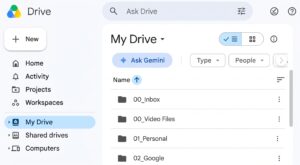
Google Drive plays a pivotal role as the core hub for digital information input and storage across the Google ecosystem. Far more than a simple cloud storage repository for saving files, it functions as a versatile hub bridging diverse applications and features, as well as the foundational workspace for intellectual output and creative production.






Comments