 Japanese
1-1: From Information Organization to Knowledge Creation in the AI Era
In the dawn of generative AI, its primary role centered on streamlining “information organization”—extracting and summarizing necessary points from vast volumes of data. At the time, the dominant approach was essentially an extension of advanced search: humans gave instructions, and the AI organized and returned existing knowledge.
Today, however, generative AI has transcended being a mere automation tool, evolving into a partner that stimulates and expands human thinking. Through dialogue with the unexpected ideas and multifaceted perspectives that AI offers, we are shifting into an era of “knowledge creation,” where humans generate unprecedented hypotheses and novel concepts.
The essence of this paradigm shift lies in a change in the master-servant dynamic. Rather than simply seeking answers from AI and passively accepting its output, the true power of generative AI in this new era lies in maximizing human creativity through “co-creation” (collaboration)—building uncharted value together.
1-2: A New Relationship Between Individual, Organizational, and Collective Knowledge
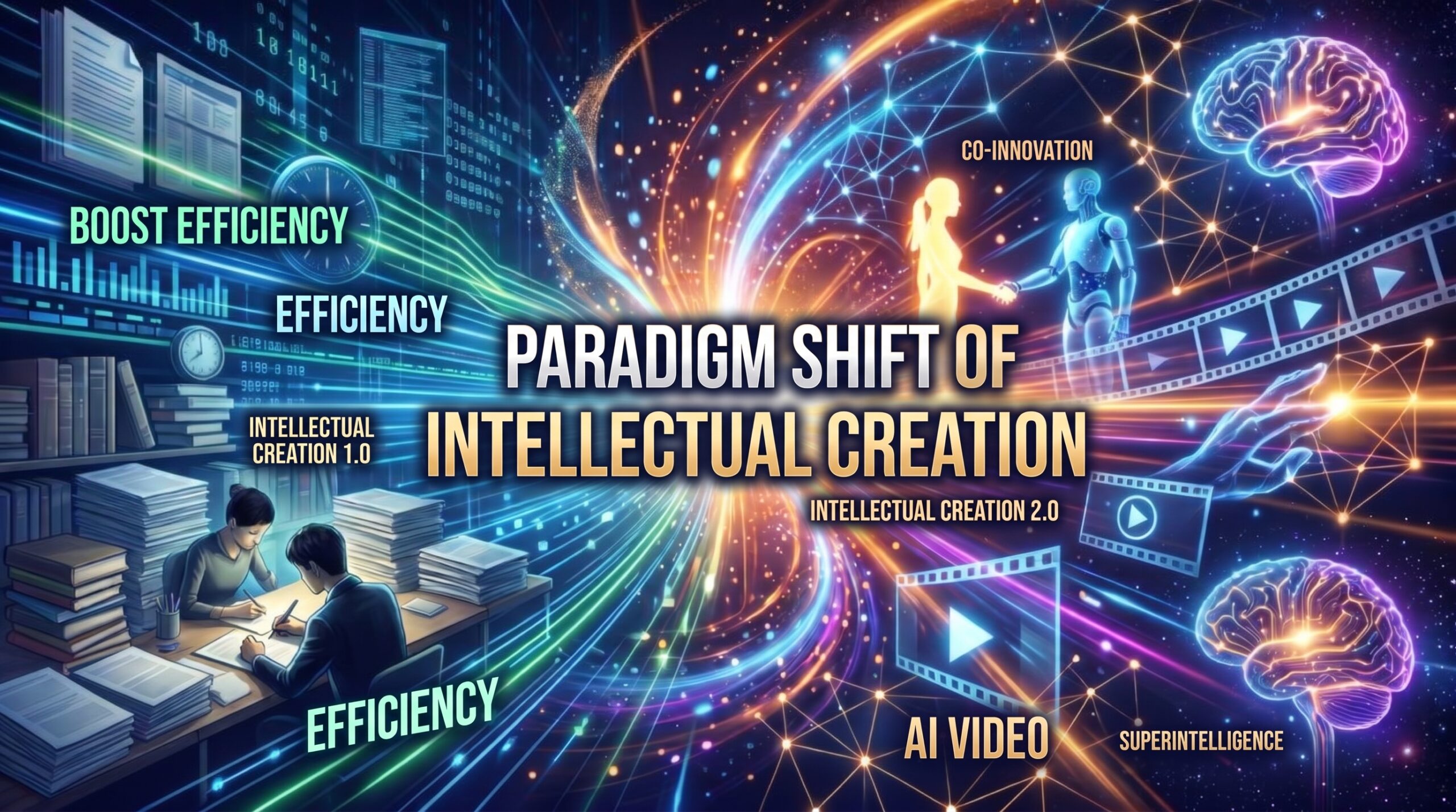
Traditionally, intellectual creation relied on solitary human endeavor and immense investments of time. The standard process required an individual to define a topic, spend countless hours gathering materials (inputs) from diverse sources—books, magazines, academic papers, and websites—digest and synthesize them mentally, and finally produce outputs in the form of text, charts, or video. Under this paradigm, the limits of an individual’s information-processing capacity and available time directly constrained the quality, quantity, and speed of the creative output.
With the advent of the generative AI era, this process has transformed dramatically. Today’s intellectual creation has evolved into a collaborative workflow with AI across every stage—from input to output—powered by web-based generative AI portals (such as the KM Method).
During the information-gathering phase, AI instantly cuts to the core of vast datasets and provides multifaceted perspectives. In the subsequent organizing and synthesis phase, ongoing dialogue with AI enables structural clarity and fresh angles unburdened by human cognitive bias. Finally, during content production, AI immediately generates draft translations, rough outlines, summaries, structural proposals, and visual prototypes. This frees humans to focus on far more essential activities: value judgments, contextual structuring, comprehensive synthesis rooted in deep insights, and creative discoveries or inventions.
This transformation goes beyond simple workflow efficiency; it is forging a fundamentally new relationship between “individual knowledge” and “organizational/collective knowledge.”
In the past, organizational and collective knowledge was formed only after laboriously gathering and database-indexing individual insights over long periods. In contrast, generative AI is pre-trained on the vast repository of collective intelligence accumulated throughout human history, granting individuals real-time access to that reservoir through conversational interfaces.
Collaborating with AI is thus functionally equivalent to being in dialogue with humanity’s collective intelligence. This establishes a high-speed knowledge cycle: an individual’s insight (individual knowledge) is instantly refined by collective intelligence, and the resulting work is fed back into organizational knowledge at unprecedented speed. Intellectual creation in the era of generative AI represents a new form of co-creation—one that expands individual capabilities while maximizing the shared intellectual assets of humanity.








Comments